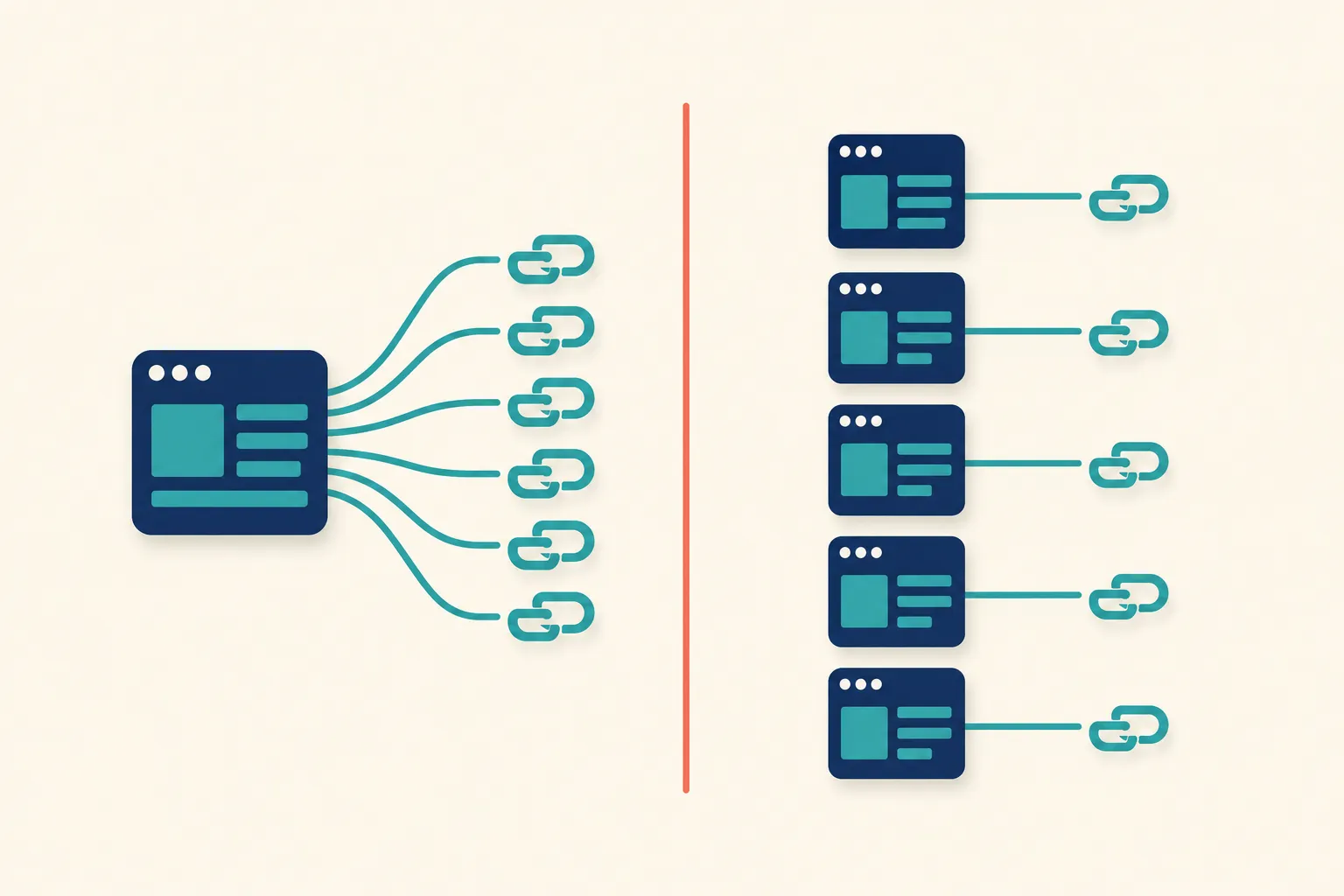
A site with 500 backlinks packed onto 5 domains carries a weaker link signal than a site with 50 backlinks spread across 50 domains, even though the first has ten times the raw link count. Backlinks count every individual link pointing at a page; referring domains count only the unique websites those links come from. Backlinko’s analysis of 11.8 million search results found that the number 1 Google result has roughly 3x more referring domains than results ranking 2 through 10, and concluded that domain diversity “has a substantial impact on rankings.” Track both numbers, but when they disagree, referring domains is the one worth acting on.
What Backlinks and Referring Domains Actually Count
A backlink is a hyperlink pointing from one page to another, and a page can carry any number of them. Ahrefs defines a referring domain as any domain from which a target page has one or more backlinks, using a simple example: a page with a backlink from the New York Times has one referring domain, a page with a backlink from the New York Times and Forbes has two, and a page with two backlinks from the New York Times still has just one referring domain.
The distinction matters because the two counts move independently. A single site can link to you from its homepage, a resource page, and three blog posts, five backlinks from one referring domain. Ten different sites can each link to you once, ten backlinks from ten referring domains. A raw backlink total treats both scenarios as equal. The referring-domain count does not.
For the deeper mechanics of why unique-domain count carries more weight than raw link volume as a ranking signal, see our guide to referring domains.
Why Domain Diversity Outweighs Raw Link Volume
Backlinko’s ranking study makes the mechanism explicit: “many SEO experts agree that getting multiple backlinks from the same domain has diminishing returns,” and the data backed it up, “it’s better to get 10 links from 10 different sites than 10 links from the same domain.” The same study found that top-ranking pages also carry more raw backlinks overall (the number 1 result averages 3.8x more backlinks than positions 2 through 10), so link volume is not irrelevant. But the referring-domain gap comes from unique sources, and diminishing returns mean each additional link from a domain you already have contributes less than the first one did.
Ahrefs reports a similar pattern from an analysis of roughly 1 billion pages: the vast majority of pages with zero referring domains get no organic traffic from Google at all, and there is a positive correlation between unique referring domain count and the amount of search traffic a page receives. Neither source claims a page can rank on referring domains alone with no relevant content, but both point the same direction: the number of distinct sites vouching for a page tracks more closely with performance than the number of links those sites happen to produce.
A Worked Comparison: 500 Links from 5 Domains vs. 50 Links from 50 Domains
The numbers below are illustrative, not a specific case study, but they show why an SEO report showing “500 backlinks” can describe two very different link profiles.
| Metric | Site A | Site B |
|---|---|---|
| Total backlinks | 500 | 50 |
| Referring domains | 5 | 50 |
| Average links per domain | 100 | 1 |
Site A’s 500 links are concentrated on 5 domains, an average of 100 links per domain. That pattern is typical of sitewide footer links, blogrolls, or a handful of partner sites linking heavily to a single destination. Site B’s 50 links come from 50 different domains, meaning 50 separate sites independently decided the content was worth linking to.
If both sites reported “we have hundreds/dozens of backlinks” without checking the domain count, Site A would look like the stronger profile. Once you check referring domains, the read flips: Site B has ten times the domain diversity, and per Backlinko’s finding above, that diversity is the metric more closely tied to top rankings.
Reading Both Numbers Together When You Audit Your Own Profile
Neither number should be read alone. Total backlinks tell you the scale of your link footprint and how much of it depends on a small number of sources; referring domains tell you how many independent sites actually vouch for you. A profile with a large gap between the two (many backlinks, few domains) is worth a closer look, not because it is automatically penalized, but because it is more fragile: losing one domain relationship can wipe out a meaningful share of your total link count in a single event.
The check itself is straightforward. Pull a backlinks export from Google Search Console or your crawler of choice, then group it by root domain instead of scanning the raw row count. Our step-by-step backlink audit guide walks through that process end to end, and the benchmarks for what a healthy profile looks like cover referring-domain count alongside the other dimensions (anchor text, dofollow ratio, velocity) worth checking at the same time.
This is also where verification work earns its keep. Once you have the domain-grouped view, running it through a tool that flags anchor-text concentration and confirms which of those links are still live turns a static export into a prioritized list: which domains are worth pursuing more links from, and which existing links need a status check before you count on them.
When a High Backlink Count Is a Red Flag, Not a Strength
A backlink count inflated by one or two domains is not just a weaker signal, it can be a spam signal. Google’s spam policies name link schemes and low-quality directory or footer links among the patterns its systems evaluate, precisely because they generate many backlinks from very few genuinely independent sources. A domain linking to you from its footer across 200 pages produces 200 backlinks and one referring domain, exactly the kind of concentration this comparison is meant to catch.
Most sites never need to act on this. Google’s own guidance is direct: “in most cases, Google can assess which links to trust without additional guidance, so most sites will not need to use” the disavow tool, and disavowing only makes sense when a site has “a considerable number of spammy, artificial, or low-quality links” that have caused, or are likely to cause, a manual action. If you’re auditing a profile and see backlink counts propped up by one or two low-relevance domains with no manual action in Search Console, that’s a case for deprioritizing those specific relationships going forward, not necessarily for filing a disavow. Our guide to when a disavow file is actually warranted covers the difference.
Frequently Asked Questions
Is it better to have more backlinks or more referring domains?
More referring domains, when you have to choose between them. Backlinko’s ranking study found the number 1 Google result has roughly 3x more referring domains than results ranking 2 through 10, and attributed the gap to diminishing returns: additional links from a domain you already have contribute less than a link from a brand-new domain.
Does getting multiple links from the same domain still help my rankings?
Yes, but with diminishing returns. The first link from a new domain typically carries more weight than the second, and by the tenth link from that same domain the marginal value is small. Backlinko put it directly: “it’s better to get 10 links from 10 different sites than 10 links from the same domain.”
Can a website have more referring domains than backlinks?
No. Every referring domain contributes at least one backlink, so the referring-domain count can never exceed the total backlink count. The two numbers are equal only when every linking domain links to you exactly once; any domain linking more than once widens the gap between them.
Why do different SEO tools show different referring domain counts for the same site?
Ahrefs, Semrush, Moz, and Google Search Console each crawl and index the web on their own schedule and with their own crawler footprint, so no two tools see an identical set of live links at the same moment. Treat each tool’s number as an estimate of the same underlying reality, not a disagreement about what a referring domain is.
Which number should I check first when auditing my backlink profile?
Start with referring domains grouped by root domain, then look at the backlink total for context. The domain count tells you how broad your endorsement base is; the backlink total tells you how concentrated or distributed those links are within it. Checking backlink count first, without grouping by domain, makes a profile look stronger than it actually is when a handful of domains supply most of the links.
Does losing one referring domain hurt more than losing one backlink?
It can. If the lost link is one of several from a domain that links to you elsewhere too, the impact is limited to that single backlink. If it’s the only link from that domain, you lose an entire referring domain at once, which is why monitoring for link drops at the domain level matters more than tracking the raw backlink count alone.
Leave a Reply