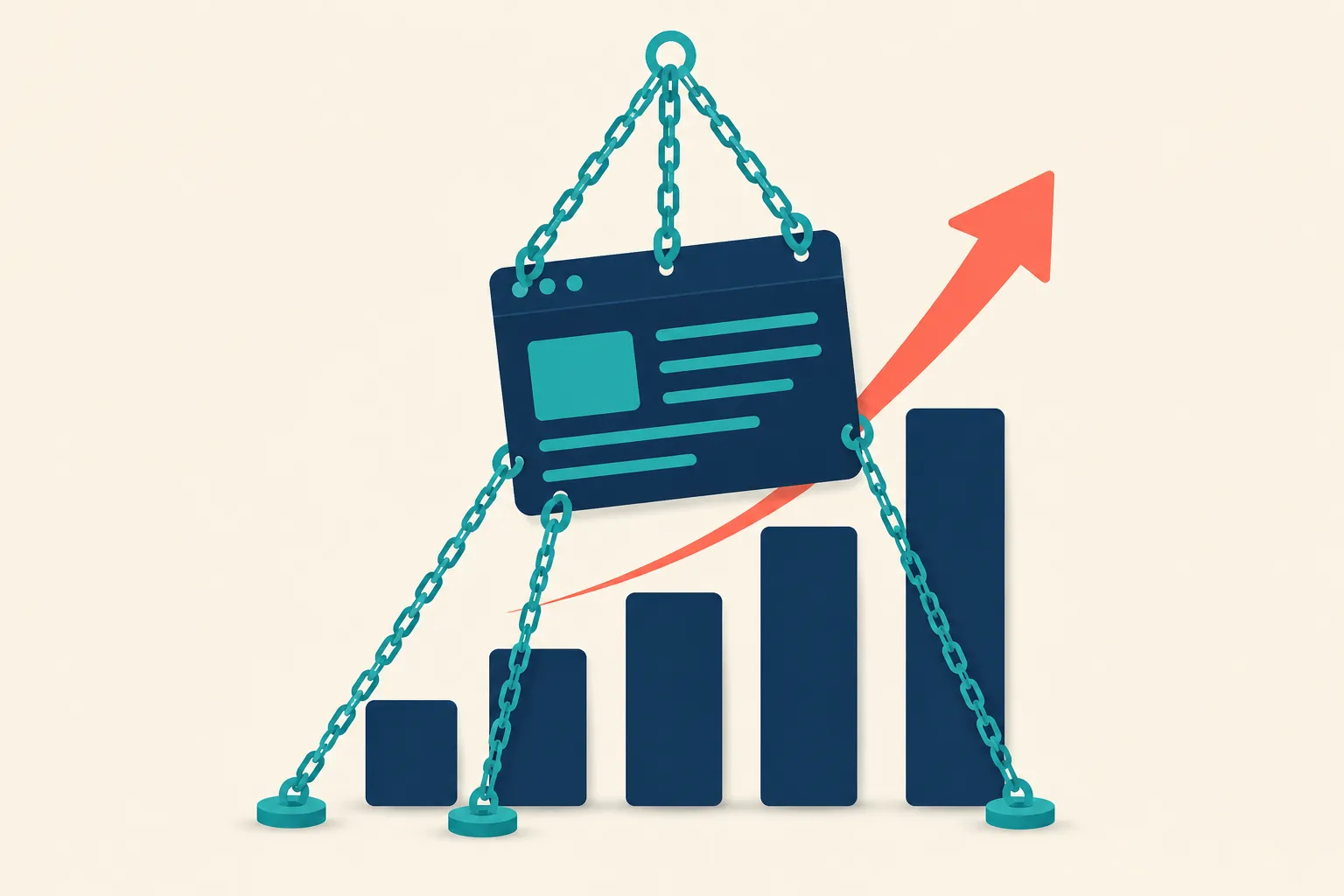
Backlinks still function as a core Google ranking and discovery signal, but their weight has shifted from raw volume toward relevance and verifiable quality. Google’s own documentation confirms it “uses links as a signal when determining the relevancy of pages and to find new pages to crawl” (Google Search Central). The evidence backs this up in practice: Ahrefs’ analysis of close to a billion pages found that of roughly 20 million pages with zero referring domains, only 2,997 pulled more than 1,000 monthly search visits. At the same time, Google’s own search analysts have said publicly that “we need very few links to rank pages… over the years, we’ve made links less important” (Search Engine Land). Both things are true at once: links still matter, and the practical work has moved from acquiring more of them to verifying that the ones you already have are still live, correctly attributed, and free of penalty risk.
Why Google Still Follows and Weighs Backlinks
A backlink is a vote from one site to another, and Google still counts those votes when deciding what to crawl and how to rank what it finds. For a full breakdown of the mechanics, see what a backlink actually is. On the discovery side, Google’s crawlers reach new pages by following links from pages they already know about, which is still one of the most reliable ways for a new page to get found at all. On the ranking side, Backlinko’s analysis of 11.8 million search results found that “the number of referring domains is one of the most important ranking factors in Google’s algorithm,” and that the authority of the linking page “has been an extremely important ranking factor since Google’s early days and still is” (Backlinko).
Ahrefs’ traffic study reinforces the same pattern from a different angle. Looking at close to a billion pages, the study found “a clear correlation between the number of websites linking to a page and its traffic,” and separately that “pages with more referring domains rank for more keywords” (Ahrefs). Correlation is not causation, and Ahrefs says as much, but the pattern lines up with what practitioners see day to day: it remains difficult to rank a page for a competitive keyword with no backlinks pointing at it at all.
The Referral Traffic Case for Backlinks, Separate From Rankings
Rankings are not the only return a backlink produces. A link placed in an article, resource page, or forum thread that still gets read sends live visitors directly to a site, and that effect has nothing to do with how Google’s algorithm treats the link. This is also where quality does the most visible work: a link from a page nobody reads (a directory listing several clicks deep, an abandoned niche blog) is close to worthless as a referral source even if it still counts as a backlink. The same signals that make a backlink genuinely high-quality, starting with whether the referring page still has a real audience, matter as much for the traffic case as they do for the ranking one.
How Google’s Public Stance on Link Weight Has Changed
The clearest evidence that backlinks’ weight has shifted comes directly from Google. Gary Illyes, a longtime Google Search analyst, has said plainly: “I think they are important, but I think people overestimate the importance of links… we need very few links to rank pages. Over the years, we’ve made links less important.” John Mueller, Google’s Search Advocate, made a related point about where SEO effort should go: “There are more important things for websites nowadays, and over-focusing on links will often result in you wasting your time doing things that don’t make your website better overall” (Search Engine Land).
Neither statement claims links stopped mattering. What changed is the ratio of effort to return. A decade ago, link volume itself was a workable strategy: enough directory submissions, guest posts, and reciprocal exchanges could move rankings on their own. Google’s spam policies now explicitly define that kind of activity as link spam, covering “buying or selling links for ranking purposes” and “excessive link exchanges,” and its algorithms are built to discount the resulting links automatically rather than reward them. The links that still carry weight are the ones a real editor placed because the content earned it, not the ones a campaign manufactured at scale.
Where to Actually Spend Your Link-Building Time Now
The practical shift is where time goes. Chasing volume returns less than it used to. Confirming that the links already earned are still doing their job returns more.
| Then (backlinks as pure acquisition) | Now (backlinks as an earned, maintained asset) |
|---|---|
| Success measured by total link count | Success measured by referring domains from real, relevant sites |
| Volume tactics: guest posts, directory submissions, reciprocal exchanges at scale | Digital PR and coverage tied to something genuinely newsworthy |
| Build the link, move to the next target | Confirm the link stays live, dofollow, and correctly attributed |
| One link audit before a big campaign | Ongoing checks for drops, nofollow changes, and 404s |
That maintenance side is where most link profiles quietly lose value. A link built through outreach eighteen months ago can go nofollow, get removed in a site redesign, or 404 without any notification reaching you. BacklinkTower’s monitoring layer runs scheduled re-checks against links already built or verified, so a dropped or devalued link surfaces as an alert instead of a rankings dip diagnosed after the fact. It works from an export already on hand (a Google Search Console links report, an Ahrefs or Semrush export, or an outreach spreadsheet), which keeps it a layer on top of those tools rather than a replacement for them.
Frequently Asked Questions
Do backlinks still matter for SEO in 2026?
Yes, but less on volume and more on relevance and verifiable quality. Google’s own search analysts have said very few links are needed to rank a page and that people tend to overestimate their importance, while still confirming links remain part of how pages are discovered and evaluated.
How many backlinks does a page need to rank?
There is no fixed number that applies everywhere; it depends on the competition for that specific keyword. The more useful approach is checking the referring-domain count of the pages currently outranking you for that keyword rather than chasing a general industry average.
Do nofollow links still have any value?
Yes. Nofollow, sponsored, and UGC links are not meant to pass ranking credit the way a standard link does, but Google’s documentation notes that pages linked this way “may be found through other means, such as sitemaps or links from other sites, and thus they may still be crawled.” A nofollow link on a page with a real audience also drives direct referral traffic regardless of how Google’s algorithm treats it.
Can having too many backlinks hurt a website?
Raw volume by itself is not the risk. What draws scrutiny is the pattern behind the links: Google’s spam policies specifically flag buying or selling links and excessive, coordinated link exchanges as manipulation, and its algorithms are built to discount links that fit those patterns rather than reward the sites that built them.
What happens to my rankings if I lose a backlink?
Losing a single link rarely produces a visible change on its own unless it made up a large share of a page’s referring-domain diversity. The bigger practical risk is not noticing the loss at all. Without active monitoring, a domain that removed a link, changed it to nofollow, or let the linking page 404 can go unnoticed for months.
Is a link from a high-traffic page more valuable than one from a high-authority page with little traffic?
They serve different purposes. A high-authority link is what Google’s ranking systems weigh most heavily, while a high-traffic link is what drives direct referral visitors regardless of what Google does with it. The strongest links do both, but a smaller, well-read niche site can still be worth pursuing even when its authority score is unremarkable.
Leave a Reply