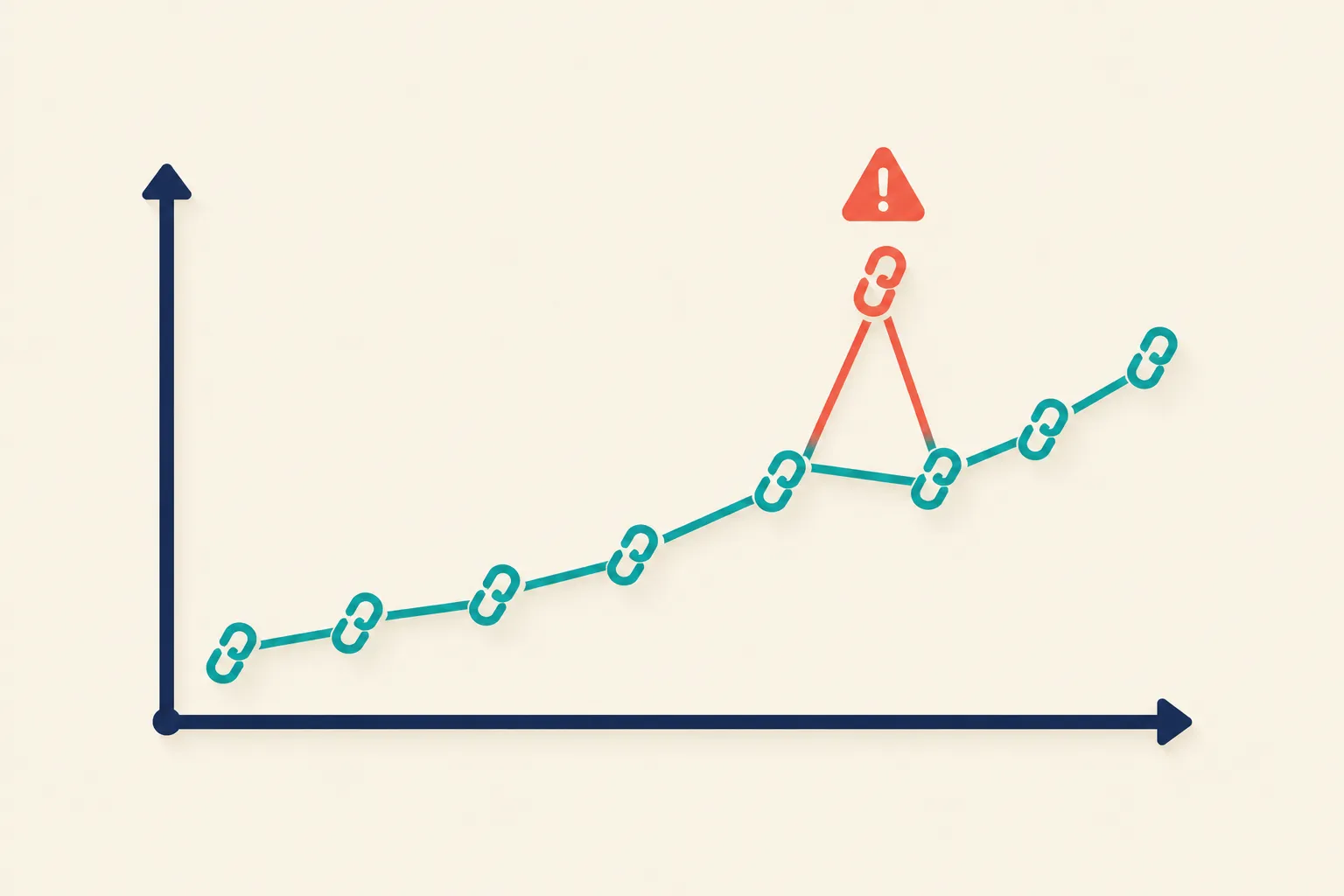
There is no fixed number of backlinks per day, week, or month that Google treats as “safe.” Link velocity, the pace at which a site gains or loses backlinks over time, only becomes a problem when a change in pace is paired with low-quality, irrelevant, or clearly purchased links. Google’s John Mueller has said as much directly: “it’s not so much a matter of how many links you get in which time period” that draws scrutiny. What matters is whether the pattern looks like real people finding and linking to your content, or like a scheme built to move rankings.
That distinction is also why a sudden spike in new referring domains is worth a closer look rather than a rule-of-thumb reaction. It might mean a piece of content caught on, or it might mean someone pointed a batch of spammy directories at your site.
What Link Velocity Actually Measures
Link velocity is the speed at which a site earns or loses backlinks over a given period, typically tracked weekly or monthly (Search Engine Land). It’s one input into a much broader picture: a healthy backlink profile also depends on referring-domain diversity, anchor-text distribution, and the dofollow/nofollow mix, and velocity only means much in that wider context.
The pace itself is relative to the site, not an absolute figure. Search Engine Land’s own comparison makes this concrete: “a small pet supply blog might earn five to 15 backlinks per month from pet directories, blog mentions, and niche forums,” while “a major pet publication could easily gain 50+ links per week.” Neither number is a target to hit. The same source is blunt about the right comparison: “Compare your link velocity to others in your niche, not the entire internet.”
Link velocity is only meaningful relative to a site’s own niche and history. A national news outlet gaining fifty new referring domains in a week is unremarkable; a small local service business seeing the same pattern overnight is a signal worth investigating, regardless of what the raw number is.
Why “X Links a Day Is Safe” Isn’t a Real Google Rule
A persistent SEO myth holds that there’s a maximum safe number of new links per day, and cross it and you invite a penalty. Google has repeatedly said this isn’t how it works. Mueller has addressed the specific version of the question, how fast is too fast, and landed on quality and pattern, not speed, as the deciding factor.
When asked about a site that had picked up roughly 200 links in two days, Mueller’s response (as reported by Search Engine Journal) was pointed: “that sounds a lot like you’re not getting natural backlinks. That sounds a lot like you’re buying them.” The objection wasn’t the count or the timeframe. It was that the acquisition pattern didn’t look like organic link building.
That lines up with how Google actually defines link spam in its own spam policies documentation: buying or selling links for ranking purposes, using automated programs to create links, and excessive link exchanges are named as violations. Speed doesn’t appear anywhere in that list. A site could add three links a month, every one of them purchased, and still be violating the policy. Another could pick up a hundred links in a week because a widely-shared article got picked up by several publications, and be entirely in the clear.
What a Sudden Backlink Spike Actually Signals
A spike isn’t automatically a red flag, and it isn’t automatically nothing either. What matters is what’s inside it.
Semrush documented one real case worth using as a reference point: a financial services site saw “500+ new backlinks appearing over a single weekend, all from low-quality business directories across Eastern Europe and Asia,” followed by “a 40% drop in organic visibility within two weeks.” That’s the negative-SEO pattern in a single example: concentrated, low-authority, geographically and topically disconnected from the site’s actual audience, and arriving all at once. For a fuller breakdown of how these attacks work and how to respond, see our guide to detecting and defending against a negative SEO backlink attack.
Compare that to what a genuine spike from real coverage or virality looks like, and the differences are consistent enough to check for:
| Signal | Organic spike (viral post, press pickup) | Suspicious spike (negative SEO, paid scheme) |
|---|---|---|
| Referring domains | Many distinct, topically relevant domains | Concentrated in a handful of low-authority directories or link farms |
| Anchor text | Varied: branded terms, URLs, generic phrases | Repetitive exact-match keyword anchors |
| Language and geography | Matches your typical audience and market | Disproportionate share of unrelated-language or unrelated-region domains |
| Timing | Clusters around an identifiable piece of coverage | Appears all at once with no traceable trigger |
| Placement | Inside relevant editorial content | Sitewide footers, sidebars, or thin directory listings |
A backlink spike is not inherently a red flag. What separates an organic spike from a negative SEO attack is the composition of the new links: diverse, topically relevant domains from a burst of coverage look nothing like a sudden cluster of low-authority directories carrying exact-match anchors.
How to Monitor Your Own Acquisition Rate
Spotting a spike after the fact in a ranking-drop investigation is the expensive way to find out. The cheaper way is knowing your baseline well enough to recognize when a pattern breaks from it.
Start with an export: a referring-domains report from Google Search Console, Ahrefs, or Semrush, pulled on a regular cadence, plotted against your historical count. Most sites settle into a rough rhythm, a handful of new domains most weeks with occasional bursts tied to specific content or outreach pushes. The point of tracking it isn’t to hit a target number; it’s to notice when a week looks nothing like the ones before it.
Once you’ve identified links worth watching, whether that’s a batch you’re investigating after a spike or a normal month of earned coverage, the work shifts from discovery to verification: confirming those specific links stay in the state you found them in. That’s the layer SEO link monitoring covers, and it’s also what BacklinkTower’s monitoring tier is built for: import the referring domains from a GSC or Ahrefs export, and get an alert if one of them changes, say a link you disavowed reappears, or a legitimate link’s anchor text gets rewritten, rather than re-running the same export and comparing it by eye every month.
When to Disavow a Spike (and When to Leave It Alone)
The instinct after spotting a spike of low-quality links is to reach for the disavow tool immediately. Google’s own guidance is more restrained than that instinct. Per Google Search Console Help, disavowing only makes sense when a site has “a considerable number of spammy, artificial, or low-quality links” that have caused, or are likely to cause, a manual action, and the same page calls it “an advanced feature” that “should only be used with caution” because misuse “can potentially harm your site’s performance in Google Search results.”
Google recommends disavowing links only when a manual action already exists or one is genuinely imminent, because the tool can strip out legitimate link equity along with the spam if applied too broadly. Used outside that situation, an overly broad disavow file can do more damage than the spike itself would have.
That caution is echoed by Google’s own staff. Semrush reports that Google’s Gary Illyes has observed that “disavow files can sometimes do more harm than good when they’re used unnecessarily or too broadly,” and that Google’s systems are “generally good at ignoring malicious or low-quality links created without a site owner’s involvement.” The practical takeaway: document the spike, watch whether it correlates with any ranking movement, and reserve disavowal for links tied to an actual or imminent manual action rather than firing it off at the first unusual export.
Frequently Asked Questions
Is there a safe number of backlinks to build per day?
No. Google has stated repeatedly that link velocity by itself isn’t a ranking factor it penalizes. What matters is whether the links look like genuine editorial links or a manufactured pattern. A site can add a handful of purchased links a month and violate spam policies, while another gains dozens of links in a week through legitimate coverage and faces no issue at all.
Can building backlinks too quickly get a site penalized?
Speed alone doesn’t trigger a penalty. Google’s spam policies define violations by tactic, buying links, automated link creation, excessive link exchanges, not by counting links per timeframe. A fast pace draws attention mainly when it coincides with those tactics, which is why an unusually quick batch of links is worth checking for quality before assuming it’s a problem.
How many new backlinks per month is normal for a small site?
There’s no universal figure. A small niche site might reasonably earn single digits to low teens of new backlinks a month from directories, mentions, and forum posts, while a site with regular press coverage could see many more in a single week. The useful comparison is against your own site’s history and similarly sized competitors in your niche, not against an industry average.
What should I do if I notice a sudden spike in backlinks?
Pull a referring-domains export and check the composition: are the new domains topically relevant and diverse, or concentrated in low-authority directories with repetitive anchor text? Check whether the spike lines up with a specific piece of coverage or outreach push. If it looks organic, no action is needed. If it looks manufactured, document it and monitor for any ranking impact before considering disavowal.
Is losing backlinks quickly as risky as gaining them quickly?
A rapid drop is usually a different problem: a site redesign, a content purge, or a domain going offline on the linking site’s end, rather than an algorithmic risk. It’s still worth tracking, since lost links mean lost equity and referral traffic, but a fast decline doesn’t carry the same spam-pattern scrutiny that a fast, low-quality gain does.
Do I need to disavow links after every unusual spike?
No. Google’s own guidance reserves the disavow tool for cases where a site has a manual action for unnatural links, or is confident one is imminent. Most spikes, even low-quality ones, get filtered out by Google’s systems without any action from the site owner. Disavowing preemptively risks removing legitimate link equity along with the spam.
Leave a Reply