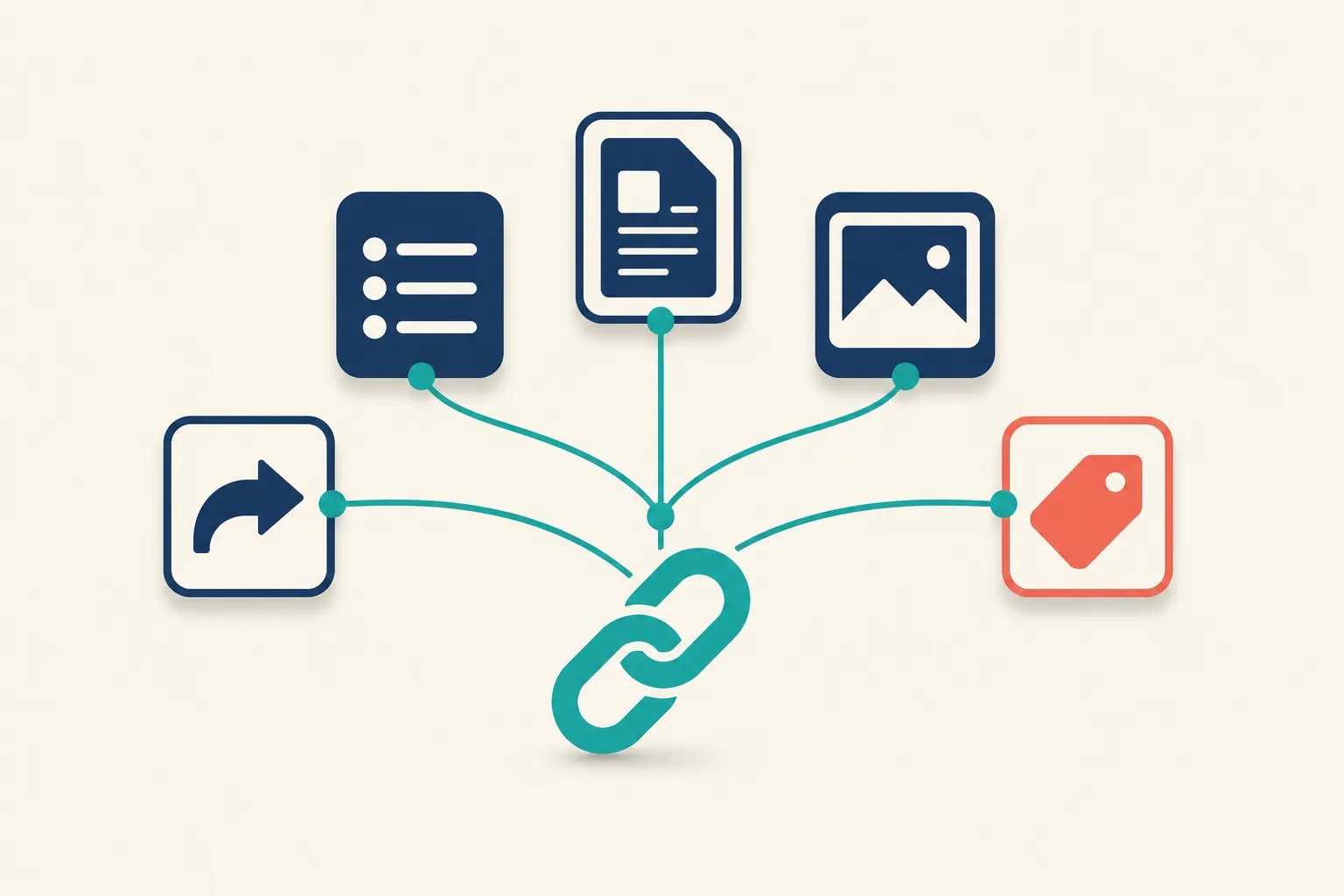
Backlinks split along two independent axes: how a link was earned and what HTML attribute it carries once it exists. An editorial link, a guest post link, and a directory listing describe three different ways a link came to exist; dofollow, nofollow, sponsored, and ugc describe what a link’s markup tells Google about it after the fact. Confusing acquisition type with attribute type is the most common mistake in link-building conversations, and it’s the first distinction to sort out before you try to read your own backlink export.
The taxonomy at a glance:
This guide breaks down both axes, then shows which acquisition types are worth pursuing versus which ones exist mainly as risk signals when you audit a profile you already have.
Backlink Types by How They’re Earned
Every earned or built backlink falls into one of a handful of acquisition categories, and which category it falls into determines most of its ranking value. The table below classifies the types most link builders and auditors actually encounter.
| Backlink Type | How It Happens | Typical Attribute | Ranking Value |
|---|---|---|---|
| Editorial / contextual | Cited naturally within another site’s content as a source | Dofollow (usually) | Highest |
| Guest post | You write content for another site in exchange for a link | Dofollow or sponsored, depending on site policy | Conditional on site quality |
| Resource page / roundup | Listed on a curated “best of” or resource-list page | Dofollow (usually) | Moderate |
| Business directory / listing | Profile created on an industry or local directory | Dofollow or nofollow | Low, with niche-relevant exceptions |
| Forum / community | Link dropped in a forum post, comment, or profile | UGC or nofollow | Low to none |
| Redirect-inherited | A 301/302 redirect points an old URL at your page | Inherits the source page’s attribute | Depends on the source page’s quality |
| Reciprocal | Two sites agree to link to each other | Dofollow (usually) | Low, devalued at scale |
| Paid / link scheme | Money changes hands for a link, without disclosure | Should be sponsored, often isn’t | Negative, policy violation |
Three of these deserve more detail because they’re misunderstood often enough to cause real classification errors.
Editorial links are what Ahrefs describes as “cited within content as an authoritative source,” and the firm notes they “can often come from high-authority sites and also drive tons of referral traffic.” This is the category every acquisition strategy is trying to approximate, because it’s the one Google can’t easily distinguish from natural citation.
Guest posts carry more nuance than most link builders assume. Backlinko states plainly that “Google has largely devalued links from guest posts” as a category, and recommends: “Only guest post on sites that are VERY picky about what they publish.” A guest post link’s value now depends almost entirely on the editorial standards of the site hosting it, not on the tactic itself.
Directory and business listing links still have a place, but Ahrefs’ own guidance is that “making these at scale on any directory, regardless of the quality, is considered yet another spammy practice.” A handful of relevant, well-moderated directory profiles is a normal part of a profile; dozens of low-quality ones is a pattern that shows up as risk in an audit.
Redirects and Reciprocal Links: The Backlinks You Didn’t Build Yourself
Two acquisition types account for most of the links that land in a profile without any active outreach: redirects and reciprocal exchanges.
When a 301 redirect points at your page from an old URL that used to carry its own backlinks, that equity follows the redirect rather than disappearing, contrary to old SEO folklore. Google’s Search Advocate John Mueller has confirmed as much, stating plainly: “We can forward PageRank through 301 and 302 redirects.” The catch is relevance. As Search Engine Journal reports Mueller explaining, “301-redirecting for 404s makes sense if you have 1:1 replacement URLs, otherwise we’ll probably see it as soft-404s.” A redirect-inherited link is only as good as the page it originally pointed to, and a classification pass that only sees the current destination misses that history.
Reciprocal links, where Site A links to Site B and Site B links back, aren’t automatically a scheme. But Google’s guidance groups “excessive link exchanges” under prohibited link schemes when the arrangement exists “exclusively for the sake of cross-linking” rather than genuine relevance. A few reciprocal links between genuinely related sites are normal. A pattern where reciprocal links make up a large share of a profile is worth a closer look.
Paid Links and Link Schemes: The Category to Flag, Not Chase
Paid links aren’t automatically against the rules. According to Google Search Central, “buying and selling links is a normal part of the economy of the web for advertising and sponsorship purposes,” and that’s fine as long as the links carry rel="nofollow" or rel="sponsored" so they don’t pass ranking credit. What crosses into a link scheme is paying for links designed to pass PageRank without that disclosure. Google defines link spam as “the practice of creating links to or from a site primarily for the purpose of manipulating search rankings,” and lists specific examples: exchanging money for links or posts containing links, using automated programs to create links, and embedding keyword-rich links in widgets distributed across many sites.
This is the category that matters most when you’re classifying an export rather than building new links. A paid or scheme-origin link sitting in a profile without the right attribute is a liability, not an asset, and it’s usually a candidate for a disavow file if the linking domain looks low-quality or irrelevant to the niche.
Attribute Values: How Acquisition Type and Rel Attribute Interact
Every backlink, regardless of acquisition type, carries one of four rel-attribute states: dofollow, nofollow, sponsored, or ugc. These aren’t a second taxonomy competing with acquisition type. They describe what the linking site is telling Google about a link it already decided to create.
The two axes correlate loosely but not perfectly. Editorial links are dofollow by default because the linking site had no reason to restrict them. Guest posts should carry sponsored under Google’s guidelines when compensation was involved, though enforcement is inconsistent, which is exactly why guest-post links are worth checking individually rather than assuming. Forum and comment links are usually ugc or nofollow by platform default, regardless of who posted them. For the full mechanics of when each attribute applies, see our guides to dofollow vs. nofollow links and rel=”sponsored” and rel=”ugc”.
Classifying the Backlinks You Already Have
None of this taxonomy matters if you can’t tell which category a given link in your own profile belongs to. An export from Google Search Console, Ahrefs, or Semrush gives you the URL and often the rel attribute, but not the acquisition type. That takes a manual or semi-manual pass: checking whether a link sits in body content (editorial), a byline bio (guest post), a directory listing, or a forum signature.
BacklinkTower is built for that pass: drop in an export and get an instant read on rel-attribute distribution across the whole profile, then use those flags to decide which links need a closer manual look for acquisition type. Once you’ve found the paid or scheme-origin links that need to go, you can generate a disavow file from the same list.
Once a profile is classified this way, what a healthy backlink profile looks like gives you benchmarks for how much of each type is normal versus a warning sign.
Frequently Asked Questions
How many types of backlinks are there?
There’s no single official count, because backlinks classify along two separate axes. By acquisition method, most SEOs recognize eight common categories: editorial, guest post, resource page, directory/listing, forum, redirect-inherited, reciprocal, and paid/scheme links. By HTML attribute, there are only four: dofollow, nofollow, sponsored, and ugc.
What’s the difference between an editorial link and a guest post link?
An editorial link is placed by another site’s own author because they chose to cite your content as a source; you didn’t write the piece it appears in. A guest post link is placed by you, or on your behalf, inside content you wrote for someone else’s site, usually as part of an agreed byline or in-body mention.
Do 301 redirects pass along the backlinks of the page they replace?
Yes. Google has confirmed that PageRank signals pass through 301 and 302 redirects to the destination URL, provided the redirect points to a genuinely equivalent replacement page. A redirect to an unrelated page is treated more like a soft 404 than a clean signal transfer.
Are business directory and listing links still worth pursuing?
A small number of relevant, well-moderated industry or local directories are a normal part of a backlink profile. Submitting to dozens of low-quality directories at once is the pattern most SEO tools flag as spammy, regardless of whether any individual listing technically breaks the rules.
Is a PBN link a type of backlink or a link scheme?
A private blog network (PBN) link looks like an editorial or contextual link on the surface, but its origin, a site built or acquired specifically to host outbound links, makes it a link scheme under Google’s guidelines. A tool that only reads a link’s attribute can’t detect a PBN; that takes investigating the linking domain itself.
Can the same backlink belong to more than one acquisition type?
No, a given link has one origin story, but it can be ambiguous which category fits from the outside. A link inside a guest post’s body copy that happens to sit on a site that also functions as a general directory, for example, should be classified by how it was actually obtained, not by what kind of site hosts it.
How do I classify the backlinks in my own export?
Start with the rel attribute, which most export tools report automatically, then check placement: body content usually means editorial or guest post, a directory profile page means listing, and a forum signature or comment means forum/UGC. Tools built for auditing an existing profile, rather than discovering new links, can flag attribute patterns and let you focus manual review on the links that look unusual.
Leave a Reply