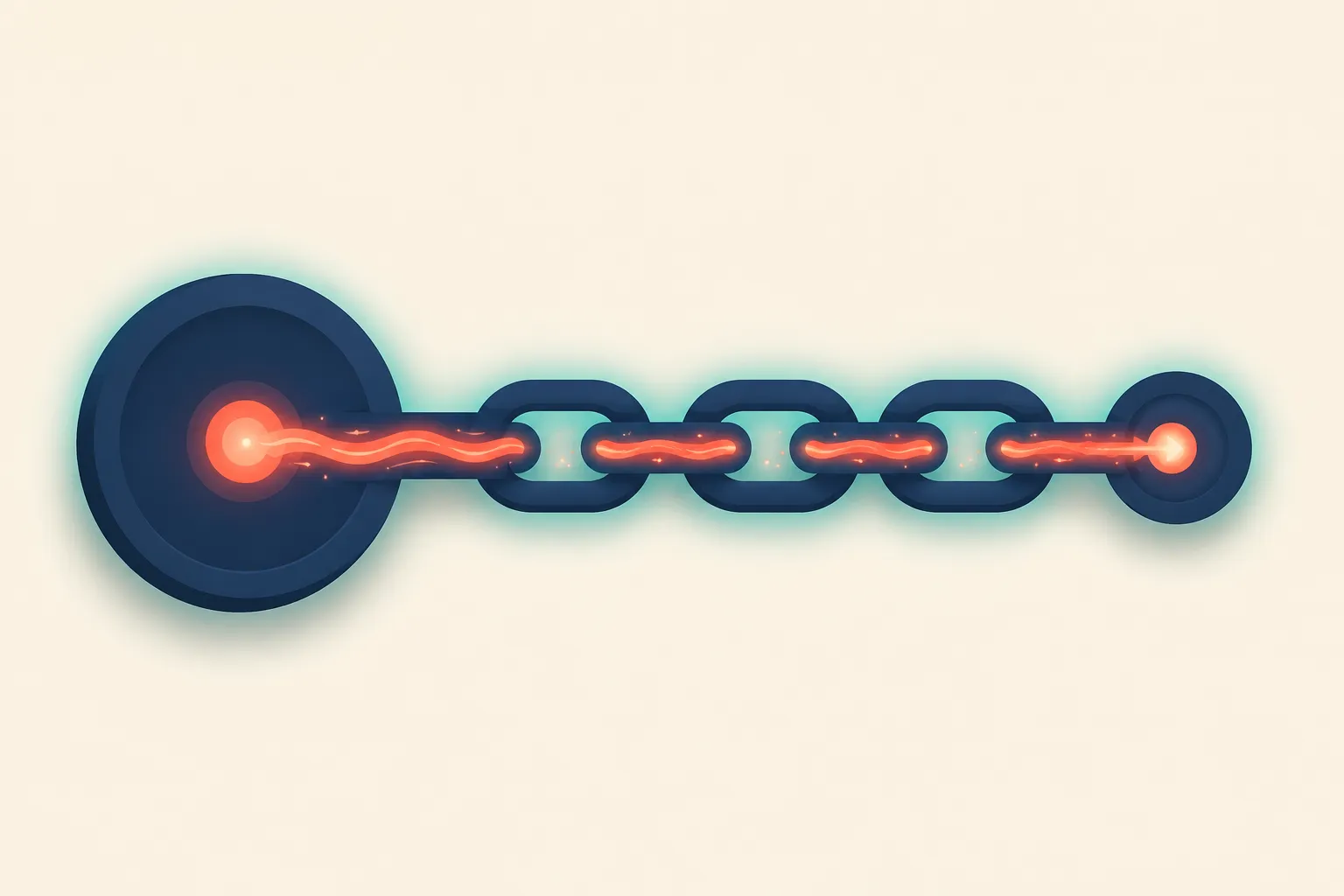
Link equity, more commonly called link juice, is the ranking value a hyperlink transfers from the linking page to the page it points to, the mechanism behind Google’s original PageRank model in which every link functions as a vote of authority. How much of that value actually arrives depends on four things: the authority of the linking page, how many other links that page sends out, whether the link carries a nofollow, sponsored, or ugc attribute, and whether a redirect sits between the link and your page. None of those four is fixed. A link that passed real equity the day you earned it can lose most of that value later if the source page piles on new outbound links or the target URL starts redirecting through a broken chain.
What Link Equity Actually Is (and Why “Link Juice” Means the Same Thing)
“Link juice” is the informal term SEOs coined; link equity and link authority describe the identical mechanic and the three terms show up interchangeably across tools and guides. Ahrefs’ glossary puts the core definition plainly: “Link equity, or ‘link juice,’ is a level of authority or value that is passed from a linking page to the page or pages it links to.” Google has never used the term itself, but the behavior it describes traces back to the original PageRank model: pages accumulate authority from the links pointing at them, then pass a portion of that authority forward through the links they make.
Only a link on an indexable page, followed rather than blocked by an attribute, can pass equity at all. Ahrefs is direct about that boundary: “Only indexable pages can pass link equity, and only via ‘followed’ links.” A backlink sitting on a deindexed page, or one carrying a nofollow attribute, isn’t degraded equity. It’s typically none at all.
How a Page Divides Its Link Equity Among the Links It Sends Out
A page’s link equity is not unlimited. Ahrefs describes the mechanic without hedging: “The link equity a page can pass on is distributed among the number of pages it links to. So the more outgoing links a page has, the less link juice will be passed through those links.” A page linking out to five relevant pages sends meaningfully more equity through each link than the same page linking out to 150.
Google doesn’t publish an exact link-count threshold, and its own guidance stays deliberately vague on the number: “However, if you think it’s too much, then it probably is.” In practice, the outbound link count on the page you earned a backlink from is one of the first things worth rechecking during a link audit. A resource page that added 40 new outbound links since you got your placement is now passing you a smaller share of that page’s equity than the day you earned it, even though nothing about your link itself changed.
Two other factors from Ahrefs’ own breakdown determine how much of that share reaches you: the authority of the linking page itself (URL Rating or Page Authority are the usual proxies, since Google no longer exposes PageRank scores), and the relevance of both the referring page’s topic and the anchor text used to link to you.
Nofollow, Sponsored, and UGC Attributes: Where Equity Gets Cut Off
Since September 2019, Google has treated rel="nofollow", rel="sponsored", and rel="ugc" as hints rather than as directives it must obey. As Google explained in its own announcement, all three link attributes (sponsored, ugc, and nofollow) now work as hints for ranking purposes. Google’s developer documentation is blunter about the practical default, though: links marked with these rel attributes will generally not be followed.
The “hint” framing means Google reserves the right to use a nofollowed link as a ranking signal in rare cases, but that isn’t the behavior to plan around. Backlinko’s own analysis states it as flatly as Google does: “nofollow links don’t pass any PageRank.” Treat any nofollow, sponsored, or ugc link as equity-free by default. For the full breakdown of when to use each attribute and what a natural mix looks like across a real backlink profile, see dofollow vs nofollow links.
None of that makes a nofollow link worthless to earn. It just moves the value out of the equity column. For what a nofollow link is actually worth (referral traffic, a natural-looking profile, content discovery), see do nofollow links help SEO?
Do 301 Redirects Still Pass Full Link Equity?
Yes, when the redirect is implemented correctly. In 2016, Google’s Gary Illyes ended years of SEO folklore about redirect decay with a flat statement, reported by Search Engine Land: “30x redirects don’t lose PageRank anymore.” A single, direct 301 to a genuinely equivalent page now passes essentially the same equity the link would have sent straight to the original URL.
“Correctly implemented” is doing real work in that sentence. A redirect to an unrelated page, a chain of several hops, or a client-side redirect Google never renders can all interrupt the transfer even though the 301 status code itself no longer causes decay on its own. That’s a large enough topic to cover properly on its own, including how to verify a migration actually preserved your backlinks and the specific mistakes that quietly break a redirect chain, in do 301 redirects pass link equity?
| Scenario | Passes link equity? |
|---|---|
| Standard followed link in body content | Yes, in full |
rel="nofollow" / sponsored / ugc link | Treated as a hint; plan for none |
| Direct, single-hop 301 to a matching page | Yes, per Google’s 2016 clarification |
| 301 through a long chain, or to an unrelated page | Often interrupted or lost |
| Link on a noindexed or deindexed page | None |
The Five-Point Check for Whether an Earned Link Still Passes Its Equity
A backlink that passed real equity on the day you earned it doesn’t necessarily still pass it months later. Five things change quietly, usually without any notice from the site that linked to you:
- Is the link still live? A redesign, a content prune, or a migration can remove a link entirely without the URL itself ever breaking.
- Has the attribute changed? A followed link can turn into a nofollow one if a site adds a sponsorship disclosure, switches CMS, or a plugin update changes its default link behavior.
- Is the linking page still indexable? A page that picks up a noindex tag, or drops out of Google’s index for quality reasons, stops passing equity even if the link itself sits untouched.
- Has the page’s outbound link count grown? A resource page that added 30 new links since you were placed on it now sends you a smaller share of the same pool.
- Does the URL redirect through anything? A site restructure can quietly route your backlink’s target through a chain, or to a page that no longer matches the original topic.
None of these five show up in a one-time backlink report. They only surface when you check the same link again later. That’s the specific gap BacklinkTower’s scheduled monitoring is built to close: it re-checks your verified link list on a schedule and flags the moment a link drops, goes nofollow, 404s, or has its anchor changed, so the five-point check above runs itself instead of depending on someone remembering to redo it by hand.
Frequently Asked Questions
Is “link juice” just an older name for “link equity”?
Yes, they describe the identical mechanic. “Link juice” is the informal term SEOs started using in the 2000s to talk about PageRank flowing between pages; “link equity” and “link authority” are the more formal equivalents used in tool glossaries and documentation today. All three terms mean the same thing.
Do internal links pass link equity, or only backlinks from other sites?
Internal links pass equity too. Any followed link on an indexable page can transfer value, whether that page belongs to your own site or someone else’s. This is why internal linking structure (linking from high-authority pages to the pages you most want to rank) is a deliberate part of on-page SEO, not just a navigation aid.
If nofollow links don’t pass PageRank, is there still a reason to want them?
Yes. A nofollow link still sends referral traffic, helps Google discover a new page, and keeps a backlink profile that is exclusively dofollow (a pattern that itself can look manipulated) looking natural. It just shouldn’t be counted on for direct ranking influence. See do nofollow links help SEO? for the fuller case.
Does linking out to dozens of other pages weaken the equity my own page can pass?
Yes. A page’s link equity is a fixed pool split across every followed link it sends out, so the more outbound links a page has, the smaller the share each individual link passes. This is why the total outbound link count on a page you got linked from is worth rechecking periodically, not just at the moment you earned the link.
If I disavow a toxic backlink, do I get its equity back?
No, and that’s not really the point of disavowing. A disavow file tells Google to ignore a link entirely because it looks manipulative or spammy, which removes downside risk rather than recovering equity, since a genuinely toxic link was rarely passing meaningful positive value in the first place. Disavowing is a risk-reduction decision, not an equity-recovery one.
Can I estimate how much equity a specific backlink is passing to my site?
Not precisely. Google doesn’t publish PageRank scores, so there’s no exact number to check. You can estimate directionally using proxy metrics like Ahrefs’ URL Rating or Moz’s Page Authority for the linking page, combined with whether the link is followed, how many other outbound links sit on that page, and how topically relevant the linking page is to yours.
Leave a Reply