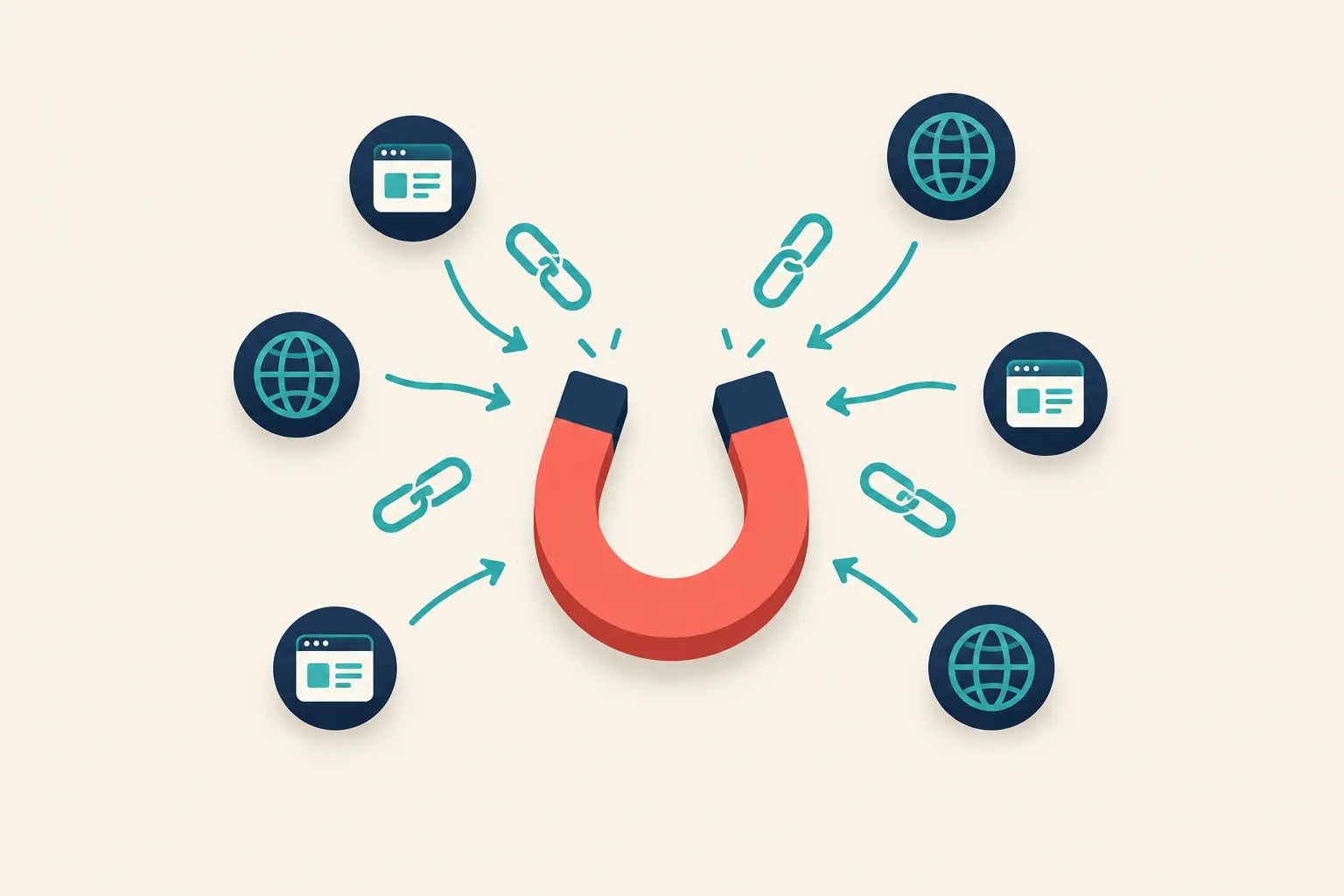
Most content never earns a single backlink. An analysis of 912 million blog posts by Backlinko found that 94% get zero external links. Getting your first batch reliably means working through four stages in order: claim links you’re already entitled to, build on relationships you already have, publish something worth citing, then run targeted outreach for what’s left. Most beginners start at outreach, the hardest and slowest stage, and give up after a dozen unanswered emails before ever trying the first three.
The Four-Stage Path to Your First Backlinks
Each stage gets harder and slower as you move down the list, which is exactly why the order matters. Stages 1 and 2 use links you can claim with almost no cold outreach. Stage 3 takes longer to pay off but compounds. Stage 4 is where most guides start, and where beginners burn out fastest.
| Stage | What You’re Doing | Example Tactic | Relative Effort |
|---|---|---|---|
| 1. Claim | Recovering links you’re already entitled to | Turning an unlinked brand mention into a link | Low |
| 2. Foundational | Earning links from relationships you already have | A supplier, partner, or chamber of commerce listing | Low to medium |
| 3. Content | Publishing something worth citing on its own merit | Original data, a free tool, a genuinely useful guide | Medium to high |
| 4. Outreach | Directly asking a site owner to link to something you built | Broken-link replacement, resource-page pitch | High |
Ahrefs’ framework for link building groups tactics into adding links yourself, asking for them, buying them (against Google’s guidelines, covered below), or earning them through content. The four stages here map onto that framework in the order that gets a brand-new site its first real links fastest.
Stage 1: Claim the Links You’re Already Entitled To
Before writing a single outreach email, check for links you’ve already earned but haven’t collected. This is the fastest stage because it requires no persuasion, only follow-through.
- Unlinked brand mentions. Search your business name and product name in quotes. Any article, review, or forum post that names you without a link is a candidate for a polite request to add one.
- Existing partner and vendor pages. Suppliers, resellers, integration partners, and software marketplaces often list customers or partners without linking to them by default. Ask to be added or linked.
- Profiles you’ve already created. Social profiles, business directories, and industry association listings you signed up for but never finished often have an empty “website” field.
- Quick expert-quote requests. Journalist request platforms let you contribute a short, specific quote to an article already being written, which is a much lower bar than pitching a full guest post.
None of these require the site to have any prior relationship with you. They require you to notice where you’re already referenced and ask for the link that should logically exist.
Stage 2: Foundational Links From Relationships You Already Have
The next easiest links come from people and organizations you already have a real connection with, not cold prospects. A single link from a real business relationship is also less likely to look like a manipulated link, because it reflects an actual connection rather than a transaction.
Look at:
- Suppliers and business partners who list clients or partners on their site.
- Local organizations, such as a chamber of commerce, a business improvement association, or an industry trade group you belong to.
- Sponsorships, even small ones. Local events, meetups, podcasts, and open-source projects frequently list sponsors with a link back.
- Alumni and community pages from schools, bootcamps, or professional communities you’re part of.
These links tend to be low volume individually, but a handful of them from clearly relevant, legitimate organizations does more for a new site’s credibility than a much larger batch of directory submissions.
Stage 3: Content That Earns Links Without an Ask
Stages 1 and 2 have a ceiling. Once you’ve claimed what you’re owed and asked everyone you know, further growth requires something other sites want to cite on its own merit, without you asking.
Long-form, data-driven content earns disproportionately more links than short posts. Backlinko’s analysis of 912 million blog posts found that content over 3,000 words earns an average of 77.2% more referring-domain links than content under 1,000 words, and that 94% of all blog posts get zero external links at all. The gap between the median post and the ones that actually earn links is almost entirely a content-quality gap, not a promotion gap.
What tends to earn links without direct outreach:
- Original data or a small original study. Even a modest survey of your own customers or a breakdown of your own usage data gives other writers something they cannot find anywhere else to cite.
- A free tool or calculator. Something that solves a narrow, specific problem in one interaction gets bookmarked and referenced in “useful tools” roundups.
- A thorough guide on a topic other posts handle superficially. Not longer for the sake of length, more specific, more current, and more complete than what already ranks.
None of this pays off in days. Content-driven links accumulate over months as the piece gets discovered, referenced, and re-referenced. That slower timeline is the trade-off for links you don’t have to individually ask for.
Stage 4: Outreach for the Links Content Won’t Attract Alone
Even strong content doesn’t get discovered by everyone who’d link to it if they saw it. Outreach closes that gap by putting your content or your case directly in front of someone who has a reason to link to it.
The tactics that work at this stage share one trait: they give the recipient a concrete reason tied to their own page, not a generic pitch.
- Broken link building. Find a page relevant to your content that links to a resource which no longer exists, then let the site owner know and suggest your page as the replacement.
- Resource page outreach. Many niches have curated “useful resources” or “further reading” pages. If your content genuinely fits, ask to be added.
- Reverse outreach through guest content. A single relevant guest post on a site your audience actually reads, with a natural, non-keyword-stuffed anchor, still works. What no longer works is guest posting at scale across low-relevance sites purely for the link.
Outreach has the lowest response rate of the four stages, which is exactly why it belongs last. Doing it after you have something worth linking to (Stage 3) and a track record of real relationships (Stage 2) gives every email a stronger opening than “I wrote a blog post, please link to it.” For the specific process and email templates that get replies, see our outreach guide.
What Makes a Backlink Worth the Effort
Not every link is worth chasing, and treating link count as the goal instead of link quality is how new sites end up with a backlink profile that looks manipulated rather than earned.
According to Backlinko’s criteria for high-quality backlinks, a high-quality backlink comes from a page that is topically relevant to yours, sits on a site with real organic traffic and genuine editorial standards, and was placed because an editor chose to include it, not because it was paid for or exchanged. Whether the link is dofollow or nofollow matters less than these three factors; a nofollow link on a highly relevant, high-traffic page can be worth more than a dofollow link from an irrelevant one. For the full breakdown of the signals to check, see what makes a high-quality backlink, and for how different link types and attributes fit together, see the complete taxonomy of backlink types.
This is also where it’s worth knowing what to avoid. Google’s spam policies define link spam as creating links to or from a site primarily to manipulate search rankings. Buying links that pass ranking credit, running automated link-building programs, and large-scale guest posting campaigns built only to acquire links all fall under this definition, regardless of whether cash changes hands. None of the four stages above require any of that. If a tactic only works because you paid for it or automated it at scale, it’s the wrong tactic for a new site trying to build a durable profile. See whether paid links violate Google’s guidelines for the exact rules and the gray areas, like gifted products and affiliate links.
Verifying the Links You Just Earned
Getting a link is not the end of the process. Ahrefs’ analysis of over 2 million websites found that 66.5% of the links pointing to those sites since January 2013 have rotted, meaning they went dead, changed, or disappeared entirely. A link you earned six months ago is not guaranteed to still exist, still be dofollow, or still carry the anchor text the site owner agreed to.
After each link goes live, three things are worth checking, and worth re-checking periodically rather than once: that the link is actually still there, that its rel attribute (dofollow, nofollow, sponsored, or UGC) still matches what was agreed, and that the anchor text hasn’t quietly changed. BacklinkTower’s free tools cover this without needing to log into a full-index platform: drop in a links export from Search Console, Ahrefs, or Semrush and check anchor text distribution, rel classification, and live status in one pass. For links you built through outreach or sponsorships specifically, the paid monitoring layer re-checks them on a schedule and flags the moment one drops, changes rel, or 404s, which matters most for exactly the relationship-based and outreach links described above, since a publisher can quietly remove or alter one long after the placement went up.
Frequently Asked Questions
How many backlinks does a new website need to start ranking?
There’s no fixed number. Competitive niches with strong incumbents may need dozens of relevant referring domains before ranking for a competitive term, while a low-competition local or niche query can rank with a handful of genuinely relevant links. Quality and relevance to the linking page matter more than hitting a specific count.
How long does it take to see results from link building?
It depends on the stage. Links from claiming and foundational relationships (Stages 1 and 2) can go live within days since you control or influence the placement directly. Links earned through content and outreach take longer, often weeks to months, and ranking changes typically lag further behind the links themselves while Google recrawls and revalues the linking pages.
Is it against Google’s guidelines to buy backlinks?
Only when the link passes ranking credit without disclosure. Google allows paid placements, sponsored content, and affiliate links as long as they carry rel="sponsored" or rel="nofollow". See what counts as a paid link for the exact rules and common gray areas.
Do nofollow links help SEO at all?
Yes, indirectly. Since 2019, Google treats nofollow as a hint rather than a strict directive, and a nofollow link from a relevant, high-traffic page can still send real referral visitors, help a new page get discovered by Googlebot, and contribute to a natural-looking link profile. See how nofollow links affect SEO for the full mechanics.
What’s the fastest way to get backlinks for free?
Stages 1 and 2 above: claiming unlinked mentions, filling in empty website fields on profiles you already have, and asking suppliers, partners, or local organizations you have a real relationship with to add a link. None of it costs money, and none of it requires the outreach skills that Stage 4 depends on.
How do I know if a backlink I earned is still helping me?
Check that the link is still live, that its rel attribute still matches what was agreed, and that the anchor text hasn’t been edited since publication. Links do decay over time, so a one-time check isn’t enough for links you care about; periodic re-checks catch drops and changes before they pile up unnoticed.
Leave a Reply