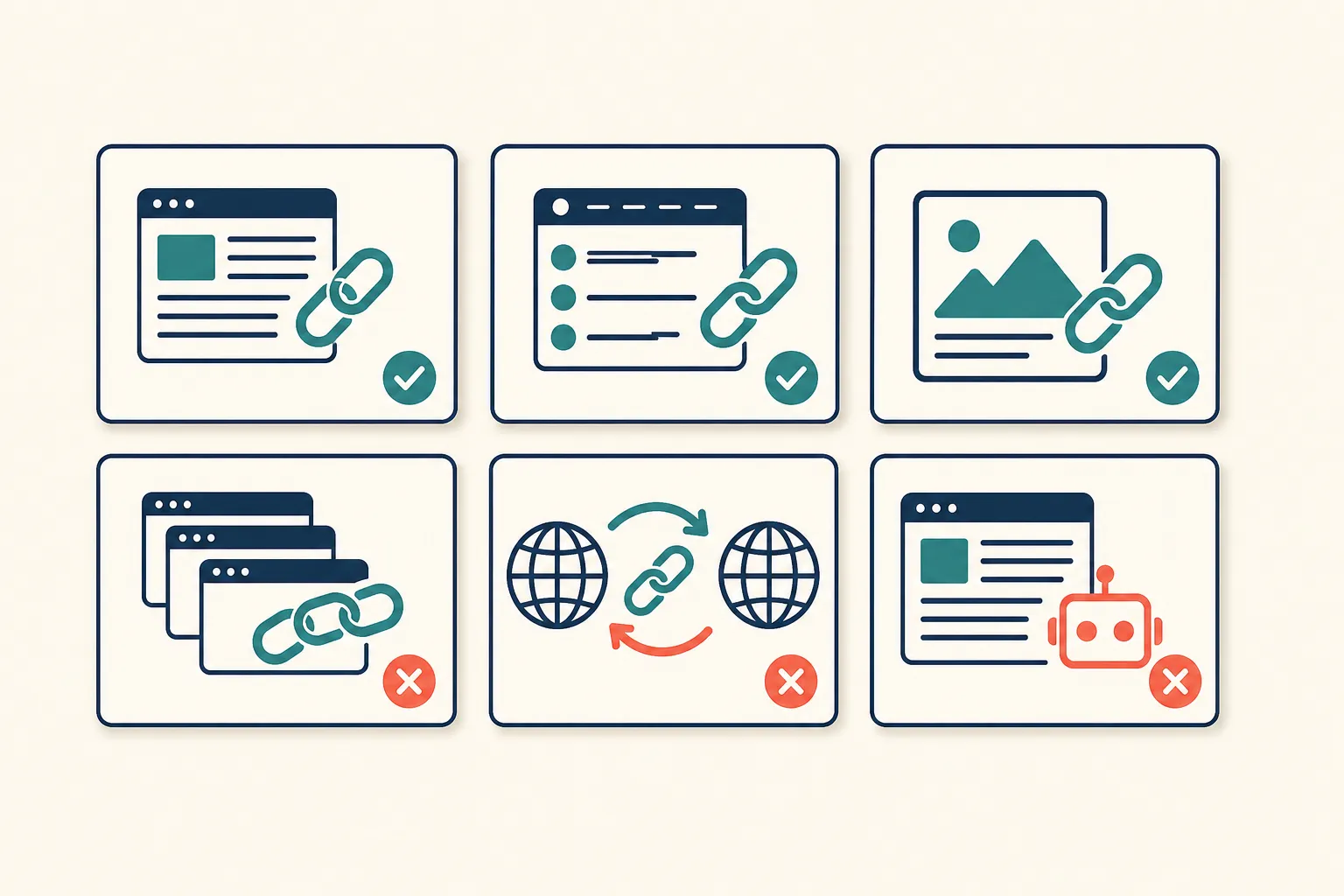
Not every link that points at your site does the same job, and some actively work against you. Below are 15 real backlink patterns, grouped into three tiers: links worth earning, links that are compliant but weak, and links that match patterns search engines treat as manipulative. If you want the underlying categories first, our complete backlink taxonomy covers the theory; this post skips straight to labeled examples you can match against your own profile.
Three tiers, at a glance:
5 Backlink Examples Worth Earning
These are links a site chose to include because they added value, not because of a payment or a swap.
1. An Editorial Mention Inside a News or Trade Article
A journalist or blogger links to your page in the body of an article because it supports the point they’re making. Backlinko’s framework for high-quality backlinks names this as the clearest case: the linking site covers a related topic, has real organic traffic, made an editorial choice to include the link, and used a dofollow tag. Its own example, Headspace picking up a link from a New York Times piece on mindfulness, checks every one of those boxes.
2. Inclusion on a Curated, Actively Maintained Resource Page
A page that rounds up recommended tools or reading in a niche adds you because an editor reviewed the list and chose to include your page. Resource page link building is common enough that 24% of SEOs surveyed for Aira’s State of Link Building report use it regularly, but the link only carries weight if the page is actually maintained, not an abandoned list nobody has touched in years.
3. A Guest Post Byline Link on a Topically Relevant Site
You write a full post for a site your audience already reads, and get a link back in your byline or naturally in the body. Guest blogging is the third most common link-building tactic, used by 47% of SEOs surveyed in the same report, which raises the bar: the post needs to be genuinely useful, not filler the host’s editor could have written faster.
4. A Journalist Citing Your Original Research or Data
You publish a survey, an analysis of your own data, or an original study, and a reporter links to it as the source for a statistic in their piece. This is the digital-PR version of an editorial link: the link exists because your page is the primary source, which tends to produce links from higher-authority sites than direct outreach for a generic guest post would.
5. An Expert Quote in an Industry Roundup
A writer asks practitioners in your field for a quote, includes yours with a link back to your site, and credits you specifically for the insight. The link is usually a single mention rather than an ongoing relationship, but it is earned through expertise, not spend.
For the checklist behind these judgment calls, see our breakdown of the 7 signals that separate a high-quality backlink from a mediocre one.
5 Backlink Examples That Add Little Value
None of these break any guidelines. They just don’t do much for you, and a profile made up mostly of these tiers plateaus even as the raw link count keeps growing.
6. A Nofollow Mention With No Surrounding Context
Your brand gets namechecked with a rel="nofollow" link, often in a listicle or a “tools we use” roundup with no explanation of why. Nofollow links don’t pass link equity the way dofollow links do, though they can still send referral clicks and put your name in front of a new audience, which is real value even without a ranking one.
7. A Guest Post on an Off-Topic Site
The post got published and the link is live, but the site covers something unrelated to your niche, so the topical-relevance signal that makes a guest post link strong is missing. It’s a link built for the link, not because the site’s editor thought their readers needed it.
8. A Thin, Low-Traffic Niche Directory Listing
A legitimate directory with real editorial review, just not much traffic or authority to pass. Not harmful, rarely helpful. Worth keeping if you’re already listed, rarely worth chasing as a strategy on its own.
9. A Syndicated Republish of Your Own Article
An aggregator or partner site reposts your article in full with a byline link back, usually nofollow and usually flagged as a duplicate by search engines in favor of your original. The link exists, but it competes with your own page rather than reinforcing it.
10. A Properly Disclosed Sponsored Placement
You pay for a mention and the publisher correctly tags it rel="sponsored", exactly as required for paid placements. It won’t pass ranking credit, but it’s compliant, unlike the undisclosed version below. See our guide to when to use rel=”sponsored” versus rel=”ugc” for the exact cases each attribute covers.
5 Backlink Examples That Put Your Site at Risk
These match the manipulative link patterns Google’s spam policies name directly, not just links a tool happens to color red.
11. A Reciprocal Link-Exchange Scheme
“Link to me and I’ll link to you,” repeated at scale across unrelated sites, is called out by name as a link scheme. A handful of natural, relevant reciprocal links between real partners is normal; a pattern of exchanges built purely to trade authority is not.
12. Comment Spam With an Exact-Match Anchor
The documented example is almost a caricature of itself: a comment like “Thanks, that’s great info!” followed by an exact-match keyword anchor buried in the name field or a signature. It’s one of the most recognizable spam patterns because the comment adds nothing to the conversation; the link is the entire point.
13. A Private Blog Network (PBN) Link
A link from a site that exists only to link out, usually built on an expired domain with some residual authority, cross-linking with a cluster of similar sites under common ownership. No real audience, no organic traffic, and a content-similarity fingerprint across the network that automated detection systems are built to catch.
14. A Low-Quality, Unmoderated Directory or Bookmark Site
Not the small legitimate directory from #8. This is a submit-your-link-for-a-fee page with no editorial review at all, which sits alongside paid links and automated link creation on the list of practices flagged as link spam.
15. An Undisclosed Advertorial That Passes Ranking Credit
A paid placement dressed up as regular editorial content, with a followed link and no sponsored disclosure. The difference between this and #10 is entirely the tag and the disclosure: the same link, correctly marked, is compliant; undisclosed, it’s exactly the advertorial pattern spam guidance addresses.
Everything above assumes these are links your own campaigns built. A link showing the same spam patterns that you never built and don’t control is a different problem: see our post on negative SEO and how to handle toxic links pointed at your site.
How to Tell Which Tier Your Own Backlinks Fall Into
The judgment calls above are easier to apply to someone else’s link profile than your own, since a link you worked hard to earn is tempting to rationalize into the top tier. In practice: pull your backlink export from Search Console, Ahrefs, or Semrush, check the rel attribute (dofollow, nofollow, sponsored, or UGC) against what the linking page is actually doing, and look at whether the referring domain has real organic traffic before deciding a link belongs in tier one. BacklinkTower runs that check against a GSC or Ahrefs export, flags rel-attribute mismatches and risky-tier anchor patterns, and re-checks on a schedule so a link that quietly slides from tier one to tier three doesn’t go unnoticed. For the small number of links that clear the bar for real risk, building a disavow file from your own export is the next step, not a default first move.
For a more systematic sweep of an entire profile against these risk patterns, see how to find toxic backlinks before they hurt you.
Frequently Asked Questions
Are all directory links bad for SEO?
No. A small, actively maintained niche directory with real editorial review (#8 above) is low-value but harmless. The risky version is an unmoderated directory that accepts any submission for a fee, which Google’s spam policies name as a link spam pattern.
Does a nofollow link do anything for my rankings?
Not directly. rel="nofollow" tells search engines not to pass ranking credit through the link, but it can still send referral traffic and put your site in front of a new audience, which is real value even without a direct ranking effect.
How is a PBN different from a normal guest-posting relationship?
A guest post goes on a real site with its own audience, content, and editorial standards, even if you pitched it. A PBN is a cluster of sites that exist only to link out, often built on expired domains, with no organic traffic and no real audience behind the content.
Do I need to disavow a single spammy comment link on an old forum thread?
Usually not. Google has stated that in most cases, its systems can assess which links to trust without additional guidance, so most sites don’t need the disavow tool at all. Disavowing is a narrow, exception-based step for a pattern serious enough to risk a manual action, not routine maintenance for one old comment.
What actually separates a paid link from a legitimate sponsored placement?
Disclosure and the rel attribute. A sponsored placement correctly tagged rel="sponsored" is compliant, it just doesn’t pass ranking credit. The same paid link without disclosure, tagged as a normal followed link, is the advertorial pattern Google’s spam policies list as a violation.
Can a legitimate guest post ever look like comment spam?
Only if it’s built the same way spam is: an off-topic post stuffed with exact-match anchors and no real value to the host site’s readers. A genuine guest post written for a relevant audience with a natural anchor doesn’t share that pattern.
Leave a Reply